Showing posts with label Discworld. Show all posts

Sunday, March 1, 2015

Learning From Amazon KDP

Buy it now at Amazon.com
It's comforting to know that my writing career follows my reading patterns. And by comforting, I mean it's a tad disconcerting.

I read prolifically. And I read things all over the map, though I gravitate towards genre fiction. But the popular stuff? I usually catch it late into the game.

There are over 40 Discworld books. I waited years to start reading them, because I didn't know where to start. Strangely enough, according to the author himself, the answer is NOT at the beginning. I always suspected as much. Terry Pratchett is nearing the end of his career, and I'm only five or so books in.

There's good and bad to this pattern. For instance, I only had to wait about a week for Harry Potter and the Deathly Hallows to come out. Most of you waited a LOT longer than that. Ha, ha.

How does my writing career reflect this? In reading, I often find myself starting things long after they've become popular, and often after the series have ended.

And, possibly, I've started indie publishing a tad late as well
.
I've used a trial of Kindle Unlimited to read a number of  How to Promote your Kindle Book Beyond All Reasonable Expectations books. Every single one of them advises you to 1) Enroll in KDP Select, 2) Do a free giveaway on your book and 3) Promote that giveaway in various ways.

Here's the thing. They all go on to say, "This used to work really well. The more you gave away, the higher your book ranked, and this translated into more real sales when the price went back up. Too bad Amazon changed the formula."` It'd sure be nice if someone would write a book that reflects the current amazon strategy.

I managed to reach #11 on one Amazon list during the promotion. But the book fell off the radar as soon as it went back to full price.
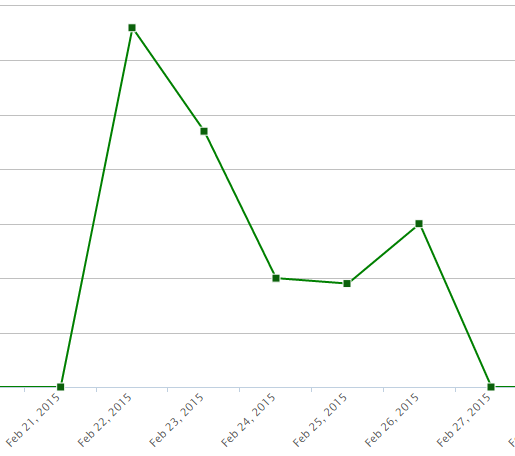
Graph of my free downloads, with no context other than date.

Free books help, but nowhere near the extent they used to. I'm convinced that the more books I have available, the more giveaways will generate sales for my other titles. And, the giveaway did translate in more reviews. I went from two 5 star reviews, to six total reviews. Five of them 5 stars, and one 4 stars, for an average of 4.8.

I learned a lot in the promotion. For instance, I learned the books were right. The first 2 days generated the most downloads, so it would have been better to spread the 5 days out over a couple of different promotions.

I also realized that I have no idea which promotions worked. I paid for a promotional gig on fiverr.com, having my book tweeted about to about 70K followers. I also submitted my book to multiple sites and email lists. The thing is, I still don't know which ones actually promoted it. And as for the fiverr gig, there's no way to know how many of those 70K followers are bots and how many are real people. I suspect the answer would disappoint me.

Here's my takeaways from the first KDP Select free book promotion:


  • Find a way to track which promotions are working.
  • Limit the giveaways to 2 days at a time. Promote each of the days differently, to see what works.
  • Be aware that the more titles available, the more overall success I'll have in total sales.
  • If nothing else, the freebies can help generate reviews. Remember to ask for reviews when promoting the freebies.


Monday, October 13, 2014

Longhand and Terry Pratchett

I've figured this writing thing out again, if only for the moment. It frightens me to think that, perhaps, I will need to relearn what works every few months.

I love my current method, even more than I despise it. Certainly, it's proving more consistent than what came before.
Photo By LeeGillion

Almost a year ago, when I started this blog, I knew what worked. The writing started anywhere from between 10:00 pm to 1:00 am. It stopped after I'd reached 1000 words. Not much of a method really, but it worked, for as long as I could sustain the pace.

A couple of problems arose. First, I would often get 4 hours of sleep. While the ensuing hallucinations made for vivid prose, some of the plots I came up with could only be understood by the reader similarly being deprived of sleep. Well, that, or (I suspect) recreational drugs.

The second issue was, in spite of consistently sitting down to write, I found myself all over the place with the actual methods. This went beyond experimentation, which I still play around with. What I mean is, I employed no real routine. And, I'm finding, routine works well for me. No. Very well.

Even if I don't want it to. Stupid pen and paper. *sigh*

Here is something I've discovered. I can write on the computer, or with pen or paper. Much to my annoyance, the writing is always better if I write it out longhand first. I think differently in longhand. The scenes flow in a way they never seem to on the computer. I'm a computer guy too, so that's hard to admit.

I learned something else. Given the correct amount of time in my schedule, I do well with word counts. Something that Neil wrote seems to have helped me find the right goal.

Yes. Him again. Neil Gaiman, may he write forever, co-wrote Good Omens with Terry Pratchett. I'm ashamed to say I haven't read much of Terry's work to date, but that's something I'm fixing. Specifically, I've read Good Omens multiple times, along with the graphic novel adaptation of Color of Magic, and also Terry's book on writing.

He's good, but I've been busy. I'm 1/4 through the novel Color of Magic now, and plan to read all of Discworld. Terry is a genius too.

I've digressed again. At the end of Good Omens, Neil mentions that when Terry still had a full-time, non-writing job, he wrote 400 words a night. It was the only way he could work and become a novelist. When Terry finished his first novel with only 200 pages written for the night, he started 200 more words on his next novel.

Brilliant.

I average about 400 words in a writing session anyway. 400 is easy. Well, except when it's harder than hammering a nail with a Phillips screwdriver. It's sometimes easy.

It worked for Terry. I'm making it work for me.

Here is my method:

First, I read. Right now, I'm reading Discworld. It might be one page, or several. Enough to enjoy the story, but not enough to keep me from writing.

Partially this is to study the craft. It also jump starts creativity.

After reading, I dive directly into at a writing session. Sometimes it's at lunch. Sometimes it's at night. The time matters less, because with longhand, I can do it pretty much anywhere that's free from distractions.

I come up with 400+ words on pen and paper. I do this consistently each day. Sometimes I'll do more. One of the first nights I tried this, I matched my previous 1000 word goal. But, I make sure the day ends with no less than 400. Two nights ago, I finished with 380, and it was all I could manage. I counted the words, and realized it was short. Even though one more word would have been impossible, I somehow came up with 50 more for the day.

Eventually, usually after 2 or 3 days, I find that I need a reminder of the story's details. That's when I transfer from longhand to the computer. This has the effect of an additional edit, as I can't help but correct as I type the story out.

On the days I transfer, I typically allow it to count as my writing for the day. Some writers, when editing, are "put-iners," while others are "take-outers." My first drafts tend to be minimalist, so I'm a put-inner. I don't count these words, but after three days, I estimate that I add about 400 if I'm typing out 3 days worth anyway. If I go beyond that, great. If not, it's okay. That's built into my new system.

It's working. A few months from now, I may share a new and improved system. Eventually, I'd love to be doing this full time, and be amused at the notion of only producing 400 words a day.